Sustainable, robust, refined
Häcker uses traditional materials in innovative ways for kitchen fronts. Linoleum has proven to be particularly robust and easy to maintain. And because it’s also extremely sustainable, it fits perfectly with Häcker’s overall philosophy.
Sustainability plays an important role at Häcker. It applies not only to the production process but, above all, to the materials used. Häcker doesn’t see itself as a kitchen manufacturer but rather as a “trailblazer for sustainable living”. “Sustainability is firmly anchored in Häcker’s philosophy. For us,
it’s a long-term approach,” explains Karin Padinger, Head of Marketing. “Häcker has always, even when the company was in its early days, been concerned with using resources in a responsible way. Perhaps this is due to our use of wood, which is a sustainable product by nature. Or perhaps it’s due to the owner’s family, who really care about the environment, social projects and ensuring a conscious use of available resources.”
Fronts made from sustainable linoleum
Since last year, the kitchen manufacturer from East Westphalia has offered a front material that is unique in terms of sustainability: linoleum. The material in itself is nothing new - lots of kitchen floors were covered in hard-wearing linoleum in the 1950s and 60s - but using it for kitchen fronts is an innovative idea. “Linoleum is our most natural raw material,” explains Jana Schäfer, Product Management Team Lead at Häcker. “Linoleum is made almost exclusively from renewable, natural materials. It’s produced using linseed oil from the seeds of the flax plant, wood flour from sustainable forestry and limestone flour.”

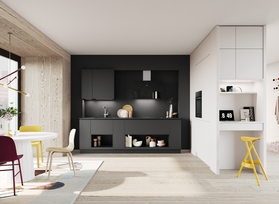
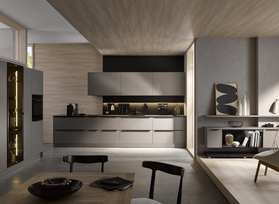
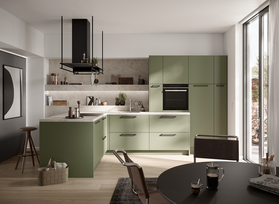
The new linoleum fronts from Häcker for the systemat range are available in the shades smoky blue, sage green, silk grey and black.
Hard-wearing and environmentally friendly material
Linoleum has an extremely long-lasting and low-maintenance surface, and it’s also very environmentally friendly and versatile. “The surface feels soft and warm,” says Jana. “And the familiar smell it gives off is very pleasant.” Linoleum in the kitchen means robust surfaces that are easy to clean. Linoleum fronts have a nice, unique feel and a matt, lightfast surface. They’re even anti-static and anti-bacterial. Linoleum is extremely hard-wearing and shows minimal discolouration even after many years of use.
„“Linoleum is something special, a truly high-grade material.”“
Combination with real oak veneer
The high-quality, matt AV 7080 linoleum fronts from Häcker’s systemat range come in four on-trend shades inspired by nature: smoky blue, sage green, silk grey and black. To give the linoleum fronts a unique look, Häcker has elegantly combined the material with real oak veneer. “We use veneer rear panels and edges to highlight the linoleum,” shares Jana. “This allows us to combine two natural materials.”
Sustainable in all areas
For younger consumers, the sustainability of products is becoming an increasingly important subject. The Häcker team is aware of this and so focuses on sustainability in all areas. “Environmentally-friendly, water-soluble paints have long been standard here at Häcker. We try to use materials that contain a high proportion of recycled materials and to use recyclable materials wherever possible,” says Jana. “Today, we use ‘Made in Germany’ PET which contains over 50 per cent recycled materials. We also use more paper for our packaging and almost no plastic. Where we would use polystyrene to cushion our products in the past, we now use scrap paper. My colleagues in logistics have come up with a new paper-based solution to secure our products during transportation. They fill sturdy paper bags with shredded cardboard scraps and then join them together. This provides perfect protection for our kitchens, allowing us to do away with the usual foam blocks and polystyrene sheets. And the proportion of recycled materials in our chipboard is now almost 80 per cent.”

The open-jointed pull-outs made from solid wood further reflect the value of the kitchen. When combined with the matt linoleum fronts, they give a warm, natural feel to the room and, even more importantly, they’re sustainable down to the very last detail.
„“Sustainability is firmly anchored in Häcker’s philosophy. For us, it’s a long-term approach and not just a passing trend.”“

Häcker is committed to sustainability – one great example of this is its tree planting campaign in spring in collaboration with Feldwerk, a charity that works together with companies to implement conservation projects. Thanks to this campaign, a total of 1,700 square metres of woodland will be planted with young oak, beech and small-leaved lime trees in 2025, as seen here with Tobias Krutemeier from Feldwerk, Jan Gutendorf from Häcker Küchen and Stefan Greinus from SV Rödinghausen (from left to right).

Sustainability is very important to Häcker
Häcker has implemented a whole host of sustainability projects. “We really put our heart and soul into our commitment to sustainability,” says Karin Padinger. “One example of this is our support for projects for renewable energies like wind and hydropower. Our company is climate-neutral, and our kitchens are manufactured in an energy-efficient way and are certified as healthy for living. Our major sustainability report has just been updated. And when visitors come to see us in Rödinghausen, they can’t miss our insect hotel, flower meadows and herb garden. We also regularly take part in projects like the local New Year’s Eve Run, where we plant one square metre of forest for every finisher.”