Viennese canework
The new fronts from Häcker pay homage to the iconic furniture seen in all Vienna coffee houses.
Viennese canework has a long history – over 200 years – but is still on trend today. When Michael Thonet designed the No. 14 Chair, also known as the coffee house chair, in the mid-19th century, he used bent wood for the frame. But when it came to the seat, he opted for a material that was light, elastic and resilient but elegant: honeycomb-shaped canework made from six strands of rattan that had been used in Austria since the 18th century. Not only is it extremely comfortable, it also provides a great contrast to the wood and gives the chair a more elegant look.
Unique structure
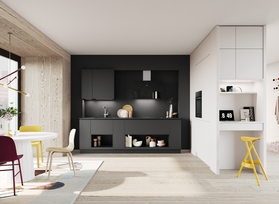
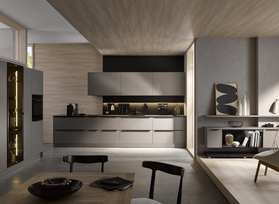
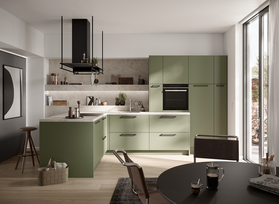
The inimitable flair of this canework immediately sprang to mind when the product managers at Häcker were designing new kitchen fronts. They eventually came up with these veneer fronts embossed with the canework pattern that were presented at the in-house exhibition for the first time in autumn 2024. Thanks to this, the minimalist kitchen furniture from the Westphalia-based manufacturer gets a unique haptic structure and a fresh, new look that fits in perfectly with the current mid-century interior design trend.

400 tonnes of pressure
“With the Viennese canework fronts, the connection between kitchen and living areas is even closer,” explains Michael Dittberner, Head of Product Development and Product Management at Häcker, another advantage of these new fronts. The finely structured design is a subtle homage to traditional craftsmanship, while the fronts themselves, made from walnut, light or black colored oak, are a masterpiece of complex, modern production technologies. “For one square metre of fronts, we need eight square metres of veneer,” Michael explains. “We start by adding two layers of fully tinted poplar veneer to the base. Then comes the top layer, the actual veneer. We apply a sheet with the canework pattern on it to the veneer with a pressure of 400 tonnes and at a temperature of 120 degrees Celsius. This embosses the veneer itself – some¬thing that has never been seen before in the industry and meets one of Häcker’s key re-quirements: ‘Be unique’.”


No other manufacturer offers kitchen fronts with this embossed, canework-inspired style. These new fronts are a real visual and sensory experience. They come in walnut, light or black oak.
An old idea for new times
If you think about it carefully, these Viennese canework fronts are a logical continuation of Michael Thonet’s centuries-old idea. While he used steam and pressure to shape the bentwood frame of his chairs, Häcker also uses pressure and high temperatures to give the wood used to make their innovative fronts their characteristic structure. Sometimes history does repeat itself.