![[Translate to English:] Cover Farbe](/fileadmin/bilder/Media/WORK/Ausgabe_27/farbe_NCS_Still-S.jpg)
White is not a colour
Our emotions and psyche are heavily influenced by colours. For example, certain colours can help you to relax. It is quite fitting that more and more green, blue and red is being included in kitchens – ultimately, it is a room where we want to feel good.
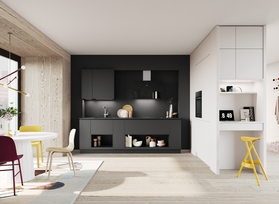
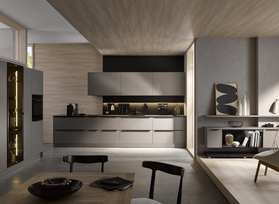
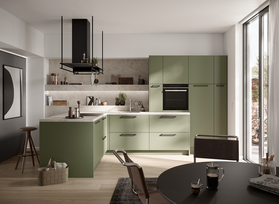
The Dutch were the first to do it. They started the trend of black kitchens, which has stuck around in many countries to this day. But they were also the first to renounce the hype and bring in some colour. Delicate, reserved, elegant shades, not the bold, bright colours you see in the light-flooded kitchens of Southern Europe. Colours like terracotta, eucalyptus and umber. Anyone that visits Häcker’s in-house exhibition in Rödinghausen can discover all of these alongside kitchens in cashmere, greige and azure blue. At the last in-house exhibition, Häcker presented the colours amaranth, greige and olive green for the SCALA model from the concept130 range.
Without colour our souls are missing something
For decades, there was only one colour used all over the world for kitchens. A colour, that is not really even a colour: white. White brings to mind cleanliness, purity. White is tidy, unambiguous, uncompromising, practical and timeless. Even the tiniest fleck of dirt had no chance of hiding. You knew exactly where you were – in the kitchen, which was a working area separate from the living areas.
Even today, six of the top ten concept130 kitchens today are still white. However, with its SCALA model, Häcker offers an entry-level range in a variety of subtle colours. And the PORTO model in eucalyptus is a favourite among customers.
Colours reflect emotions and are important for our psyche. Anyone who spends all their time in all-white rooms can become ill, because their eyes and soul are missing something. When you head to the beach and look out to the horizon over the turquoise ocean, don’t you feel more relaxed straight away? We need colour in our lives.
Colourful doesn't have to mean garish. “At the moment, the trend is for refined dark brown with metals like gold and earthy, natural colours that are not too striking,” explains Yvonne Vogler, Häcker-Campus Training Manager and Colour Specialist. “Colours that are in harmony with nature and let you escape from virtual reality. For example, I never thought that green would come back as a trend like it has over the past two years. Green comes in a wide range of tones, like our pastel or eucalyptus shades, for example.”
Unlike with fashion, with kitchens and interiors you do not have to worry that the on-trend colour will change quickly and that next year, a bold red might be the popular shade. As Vogler learned, “it tends to happen in smaller steps.”

Meeting everyone’s colour wishes
You have to learn to be courageous with colour. Look at kitchen studios, for example, which often showcase colourful kitchens and where samples are available in a wide range of hues and shades. “Theoretically, you can get kitchens in any colour. We can offer seven programmes from our systemat range in any NCS or RAL shade. This way, we can meet everyone’s colour wishes,” explains Vogler. “It has enabled us to fully lean into the trend of kitchen customisation.”

Why men suddenly get excited about kitchen colours
NCS, a scientifically based colour notation system, was introduced as the Swedish national standard for colours in 1979. Today Karl Johan Bertilson, creative director at NCS, is responsible for the further development and new trends. “NCS can be used to explain a few aspects of colour differently,” says Vogler. “With NCS, it has been possible to get men, who would not normally be interested, excited about the topic of kitchen colours. It works so well because NCS approaches colour in a mathematical way that anyone can understand quickly and easily.”
![[Translate to English:] Yvonne Vogler](/fileadmin/bilder/Media/WORK/Ausgabe_27/farbe_WORK_NCS_Yvonne_Vogler_6.jpg)
With NCS colours can be precisely determined
Not everyone perceives colours the same way. If you said “apple green” for example, everyone would imagine something different. NCS offers up over 2000 standard colours that have been mathematically defined. Using a formula, the colours can be precisely determined and nuances can also be taken into account. This means that lighting conditions and surrounding colours can be incorporated in the final colour identification. Once the end customer decides on a colour, the paint colour is carefully created based on this information. The free NCS Plus app helps consultants to offer complementary colours and can be used to ensure that the colours always fit together perfectly.
It often comes down to the nuances
Vogler has another tip: “A Colourpin linked with the app can determine the exact NCS colour of a sample that a customer might bring with them, regardless of whether it is a curtain, tiles, furniture or flooring.”
When it comes to kitchen colours, it often comes down to the nuances. And this is exactly what helps to create a harmonious overall image. A kitchen with fronts painted in NCS S 2005-Y20R instead of white contains – at least according to the formula – 20 per cent black and 5 per cent colour, the latter being a yellow that contains 20 per cent red. “You might then notice that this NCS white looks a lot better with another front colour, wood or decorative element than with standard white,” explains Vogler. “The kitchen appears to be of a higher quality, has a wow effect and the customised paint actually only costs a little more than the standard colour.”
![[Translate to English:] Küche dunkel](/fileadmin/bilder/Media/WORK/Ausgabe_27/farbe_AV7030_Black_Star_AV6000_NCS_S_5010_B50G_M.jpg)
Be courageous!
“Lots of people worry about choosing an on-trend colour when investing in something like a kitchen,” explains Vogler. “They think that fashions will change and then they will be stuck with an outdated kitchen for the next 20 years. It can be difficult to convince them that opting for a colour would be good. They often take the easy way out and say: well, we’ll take the kitchen in magnolia but we’ll make the wall, the neighbouring room or the opposite wall bolder. You can also play around with colour on the walls, not just on the fronts. And you can add accents. For example, you can try painting wall cabinets in a different colour to the base units. You can then match them to other elements in the dining or living room.”
Playing around with colours
Light plays an important role when using colour. “With NCS we are able to produce colours that are as precise as possible down to the last half per cent, but then it can all be ruined if someone installs poor lighting,” says Vogler. “This issue often starts with the display kitchens. Most do not have natural light and are not optimally lit. As a customer, I want to see the kitchens in the right light. But when it is too dark and there is only artificial light, it can be difficult to differentiate between cashmere and satin, anthracite and a dark blue. And with black, it is really complicated. For colourful kitchens to work, they need good lighting. Colour simply does not work without light. For me, the best kitchen consultations happen at the customer’s home when I can see the space and the lighting conditions and show them the samples in the lighting that they actually have in their kitchen.”
Photos: © Häcker Küchen © NCS Colour
You might also be interested in
Alle Artikel