In this article, we’ll share practical tips and clever ideas on how to organize your kitchen efficiently—from well-organized drawers and thoughtfully designed pantry cabinets to helpful storage systems. Get inspired and discover just how much joy a well-organized kitchen can bring.
Why is kitchen organization so important?
A well-thought-out kitchen organization is about much more than just keeping things tidy. It creates structure, saves time, and ensures that you feel completely at home in your kitchen. After all, when everything has its place, everyday life becomes much more relaxed—whether you’re cooking, cleaning up, or shopping.
The key benefits of a well-organized kitchen at a glance:
- Greater efficiency in everyday life: You’ll find things faster, save yourself unnecessary trips, and cook with greater ease.
- Optimal use of space: Even small kitchens often have untapped potential—with the right kitchen organization, you can make the most of it.
- Longer-lasting food: A clearly organized pantry helps you keep track of what you have—so you avoid buying duplicates and creating unnecessary waste.
- Less wear and tear on kitchen utensils: Storage systems protect pots, pans, and knives from damage—extending their lifespan.
- Less stress and more enjoyment: A tidy, well-organized space creates a sense of calm and makes you want to cook.
- A tidy, harmonious overall look: A perfectly organized kitchen is not only functional but also aesthetically pleasing—making it more inviting for you and your guests.
In short: With smart kitchen organization, your kitchen will not only become more functional, but also more sustainable—and a place where you’ll enjoy spending time.


The Basic Principles of Kitchen Organization
Before you reorganize your kitchen, it’s worth taking a step back—literally. After all, a functional and well-thought-out kitchen layout starts with a clear understanding of what you really need. With these three steps, you can lay a solid foundation for order and clarity.
Rearrange everything and start thinking about it right from the kitchen planning stage
If you’re planning a new kitchen, it’s worth thinking about how to organize it well in advance. A well-thought-out layout will save you time, space, and stress in your daily life. Before you simply move your old items into new cabinets, it’s a good idea to start fresh—with the mindset that only what makes sense should make the move.
- Get an overview: Take the time to systematically clear out all your kitchen cabinets and drawers. This will help you see what you actually own—and what you really need. If you’re planning a complete kitchen remodel, it’s a good idea to take inventory of your kitchen items before you start planning, so you know exactly how much space you’ll need.
- Decluttering saves space: Ask yourself about each item: Do I use this regularly? Is it a duplicate, damaged, or simply unnecessary? Anything you don’t need can be thrown away, given away, or donated.
- Start with a clean slate: Take this opportunity to do a deep clean. Clean surfaces provide a solid foundation for future organization.
This careful planning will help you set up your new kitchen in a structured and organized way—and ensure a tidy start to your new cooking routine.

Organize kitchen utensils by category
Now it’s time to bring some order to your kitchen organization. You should sort everything you want to keep into practical categories—that way, you can efficiently organize your kitchen cabinets and drawers later on.
- Create categories such as “Breakfast,” “Baking,” “Spices,” “Cooking Utensils,” “Pots and Pans,” “Pantry,” or “Cleaning Supplies.”
- Also consider special areas, such as kitchen organization around the sink or pot storage.
- Items that are frequently used together should also be stored together—this makes daily routines easier.
This type of grouping not only makes it easier to put things away, but also to find them later—a key principle of successful kitchen organization.

Use practical storage solutions
To ensure your new organization system works in the long run, you’ll need some smart solutions. There’s a wide variety of kitchen organization systems available—and many of them are specifically designed for certain areas or purposes.
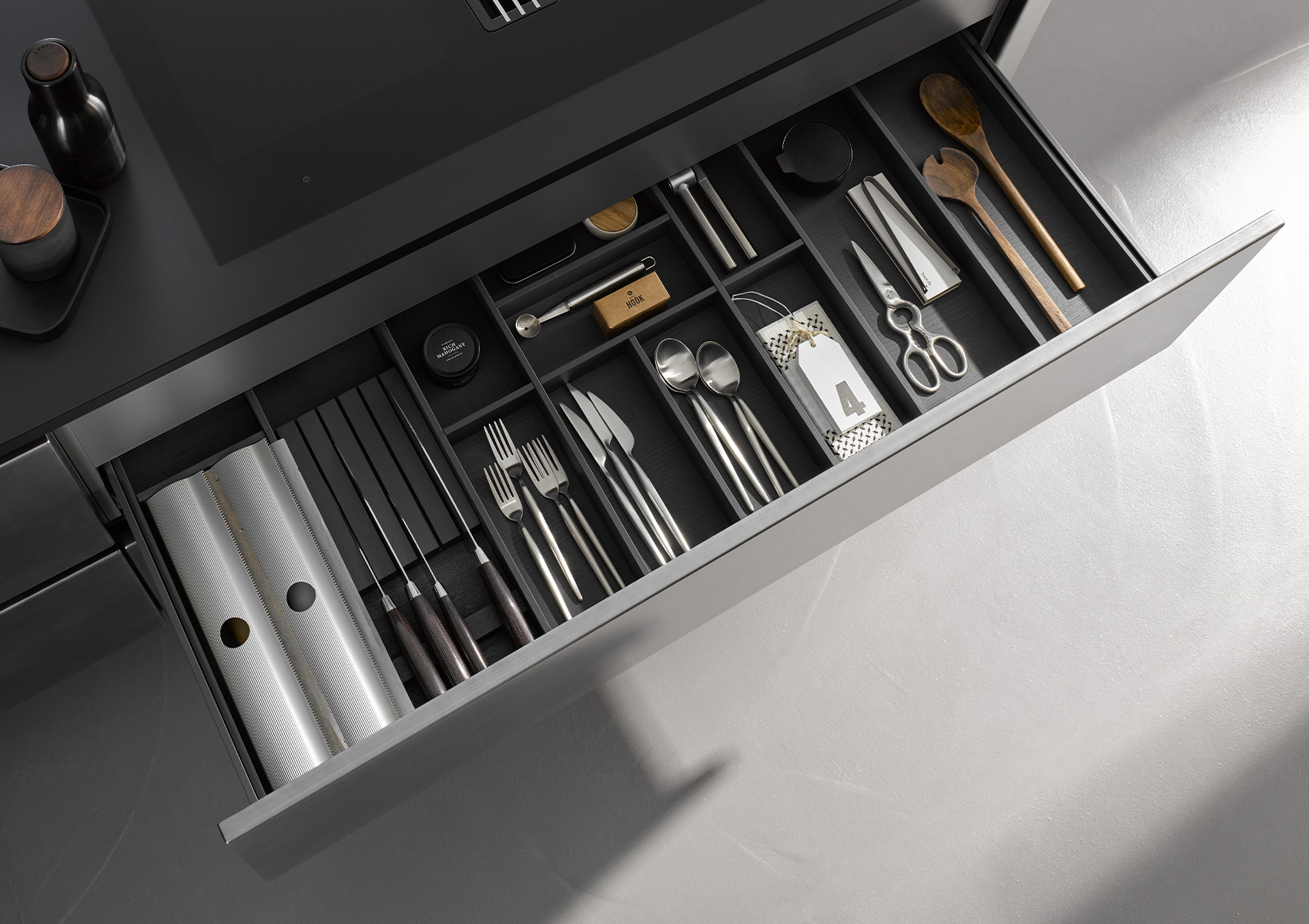
- Use cutlery trays or drawer organizers to neatly store cutlery, cooking utensils, or small items.
- Use storage containers to keep dry foods airtight and save space—ideal for organizing your pantry.
- Rotating shelves, hanging systems, or pull-out baskets can work wonders for organization, especially in deep cabinets.
- For the area around the sink, there are special pull-outs for under-sink cabinets that let you cleverly store sponges, cleaners, and other items.
Investing in high-quality, well-designed storage solutions not only helps keep your kitchen cabinets organized, but also ensures that everything is quickly within reach—right where you need it.

Tips for organizing kitchen cabinets and drawers
If you want to keep things tidy in the long run, it’s essential to organize your kitchen cabinets and drawers smartly. With a well-thought-out system, you can create a clearer layout, avoid clutter, and make the best use of the available space. The following tips will show you how to efficiently organize your kitchen cabinets and drawers.
How to Organize Your Kitchen Cabinets Effectively
- Apply the zoning principle: Organize your cabinets by function—for example, cooking zone (pots, pans, oil, spices), dishwashing zone (cleaning supplies, trash bags, sponges), and prep zone (bowls, cutting boards).
- Use vertical space: Use stackable shelves or inserts to make use of the space above plates or glasses.
- Make clever use of the inside of cabinet doors: Hooks, organizers, or small shelves create additional storage space for lids, cutting boards, or spices.
- Pull-out inserts or rotating shelves: Ideal for deep cabinets—so you can keep an eye on everything, even at the very back.
This method of organizing kitchen cabinets not only saves space but also cuts down on the time spent looking for things in your daily routine.
Organize drawers smartly
With the right organization, drawers can become true organizational wonders.
- The toolbox principle: Organize utensils by how often you use them and their function—knives in the front, rarely used cookie cutters further back.
- Use modular dividers: Flexible systems can be adapted to your contents—e.g., made of bamboo, plastic, or felt.
- Set up themed drawers: One drawer for baking, one for breakfast, one for meal prep—this saves time.
- Vertical storage in deep drawers: Store pots, pans, and storage containers upright using holders instead of stacking them.
Here's how to keep your kitchen drawers organized—without having to rearrange them all the time.
Organizing Your Pantry
A well-organized pantry isn't just helpful for cooking—it's also helpful when shopping. After all, keeping track of your supplies helps you avoid unnecessary purchases—and thus reduces food waste.
- Use clear, labeled storage containers so you can quickly see what’s inside.
- Sort by categories such as “Breakfast,” “Baking Ingredients,” “Canned Goods,” or “Snacks.”
- Store older items in the front and newer ones in the back—this way, you can keep track of expiration dates.
- Use small boxes, baskets, or shelf risers to make efficient use of space.
Keeping your kitchen cabinets well-organized—especially when it comes to pantry items—not only helps you see everything at a glance but also brings structure to your entire kitchen organization.


Specific Areas of Kitchen Organization
Some areas of the kitchen just never seem to stay tidy for long—the sink, the pot cabinet, and the spice rack are among the most common “problem areas.” But with a few well-thought-out strategies, you can get these areas under control for good. Here are some practical tips to help you bring more order to your kitchen.
Tidiness at the Sink
It’s especially around the sink that clutter tends to pile up: dish soap, brushes, rags, and sponges are left lying around, spoiling the overall look.
Here's how to keep this sensitive area organized and clean:
- Make use of hidden storage: Install small organizers in the sink drawer or under the sink—for dishcloths, dish brushes, or dishwasher tablets.
- Dual-purpose drain rack: Modern models provide space for sponges and let the water drain away immediately—which prevents odors.
- Magnetic strips or suction cup holders on tiles or the sink: Handy for brushes or soap dispensers.
- A clearly designated spot for dish soap—for example, in a nice container or tray—ensures a tidy appearance.
These ideas will make organizing your kitchen around the sink much easier—and the area will look neater and more inviting.
Space-saving storage for pots and pans
We’ve all been there: pots and pans are bulky, make a lot of noise when you take them out, and are often hard to stack. But with a few simple tricks, you can reclaim some valuable space—and enjoy a quieter daily routine.
Here's how to organize your pots in the kitchen:
- Vertical dividers for pans or lids – no more rattling when you take them out.
- Store lids separately, e.g., on the inside of the door or in special inserts.
- Stack items by size—from largest to smallest—and regularly sort out what is no longer needed.
- Felt inserts for pans not only prevent scratches but also reduce noise
With a well-thought-out organization system for your kitchen cabinets, everything stays within easy reach—without feeling like you're stuck in a game of pot Tetris.


Keep spices within easy reach and organized
Spices are the soul of every dish—yet they’re often a source of clutter. With so many different jars, bags, and containers, it’s hard to keep track of everything. Here’s how to keep things organized and easy to find with minimal effort:
- Matching spice jars with labels—visually appealing and easy to grab.
- Spice racks or pull-out drawers with spice inserts– ideal for quick navigation.
- Alphabetical sorting or grouping by cuisine (e.g., “Asian,” “Mediterranean”) saves time while cooking, as is possible with this universal spice jar insert
- Magnetic strips on the wall or the inside of cabinet doors: space-saving and decorative.
- Extra tip: Place your spices directly below the cooktop, if space allows. That way, you don’t have to step away from the stove to find the right spice.
Organizing your spices in a structured way keeps things tidy—and makes seasoning more intuitive and enjoyable.
Innovative organization solutions for your kitchen
A well-organized kitchen isn’t just about decluttering and sorting—it thrives on clever tools that make everyday life noticeably easier. Modern kitchen organization solutions ensure that every move is efficient and nothing gets in the way unnecessarily. Whether for large or small kitchens, these innovations help you gain more clarity, space, and enjoyment while cooking.
Handy tools for a tidier kitchen
Organization starts with the little things—and that’s exactly where smart organizers come in. If you want to improve your kitchen organization for the long term, these products are especially helpful:
- Drawer dividers and cutlery inserts:Keep every drawer organized—perfect for knives, spoons, kitchen utensils, and more.
- Baskets and boxes with handles: Perfect for storing supplies in cabinets or the refrigerator—stackable, removable, and transparent.
- Hook rails and railing systems: Aesthetic and useful kitchen accessories, such as the Linero MosaiQ railing from Häcker, create new hanging options for cooking utensils, towels, or cups on walls or the insides of cabinets.
- Lid holders, dividers, and pot lid organizers: Ensure better organization and less rattling in base cabinets.
With these kitchen organization tools, you’ll not only free up space—you’ll also make your daily kitchen tasks easier.


How to Organize Your Kitchen for Maximum Efficiency
A well-organized kitchen is more than just tidy—it makes your daily life noticeably easier. When everything is exactly where you need it, you save not only time but also energy and stress. In this section, we’ll show you, step by step, how to set up your kitchen in a functional and ergonomic way—tailored to your personal cooking habits.
Place frequently used items in convenient locations
The key to smart kitchen organization is all about proximity: the items you use every day should be easily accessible and within reach.
- Store frequently used kitchen utensils such as wooden spoons, whisks, or spatulas in a drawer directly under the countertop or in a decorative container next to the stove.
- Cups and breakfast plates belong in upper cabinets near the coffee maker or breakfast nook.
- Spices and oil bottles should be kept close to the stove—but not where they’ll be exposed to unnecessary heat.
If you organize your kitchen this way, you’ll save yourself unnecessary trips—and everything will be right where you need it.


Ergonomic layout for comfortable working
An ergonomically designed kitchen is easy on your back, your joints—and your patience. A smart layout really pays off, especially when you’re doing repetitive tasks or spending long hours in the kitchen.
- Arrange your work areas according to the so-called work triangle: the refrigerator, sink, and stovetop should not be too far apart to avoid unnecessary walking.
- Store heavy items at waist height, such as pots or kitchen appliances. This helps you avoid uncomfortable bending or lifting.
- Use pull-out shelves and drawers instead of deep cabinets to easily reach everything.
- Keep all essential kitchen tools within easy reach—the less you have to stretch or bend, the more relaxed your cooking will be.
- Extra tip: Consider installing pocket doors from Häcker. This way, you can make your kitchen utensils disappear behind doors in the blink of an eye.
When setting up a new kitchen, it’s especially important to pay attention to ergonomics—it pays off in the long run.

Conclusion – The Benefits of a Well-Organized Kitchen
A well-organized kitchen is much more than just a thing of beauty—it makes your daily life easier, saves you time and stress, and ensures that cooking is fun (again). By organizing your kitchen systematically, you not only create more space and a clearer layout, but also extend the shelf life of your food and kitchen utensils. At the same time, you’ll reduce waste and, as a bonus, improve the aesthetics of your home.
What you should take away:
- Organize and arrange your kitchen cabinets regularly—this creates clarity and space.
- Keep frequently used utensils within easy reach to streamline your workflow.
- Use organizational aids like dividers, baskets, or hooks to make the most of your drawers and cabinets.
- Keep ergonomic principles in mind—they make working in the kitchen noticeably more comfortable.
- Don’t forget the small areas either: spices, the sink, or pots often cause chaos, but can be organized effectively with the right tricks.
Take this opportunity to rethink your kitchen—whether you’re planning a new one or want to redesign your existing one. With a little time and the right tips, your kitchen will become a space that’s not only practical but also inspiring.