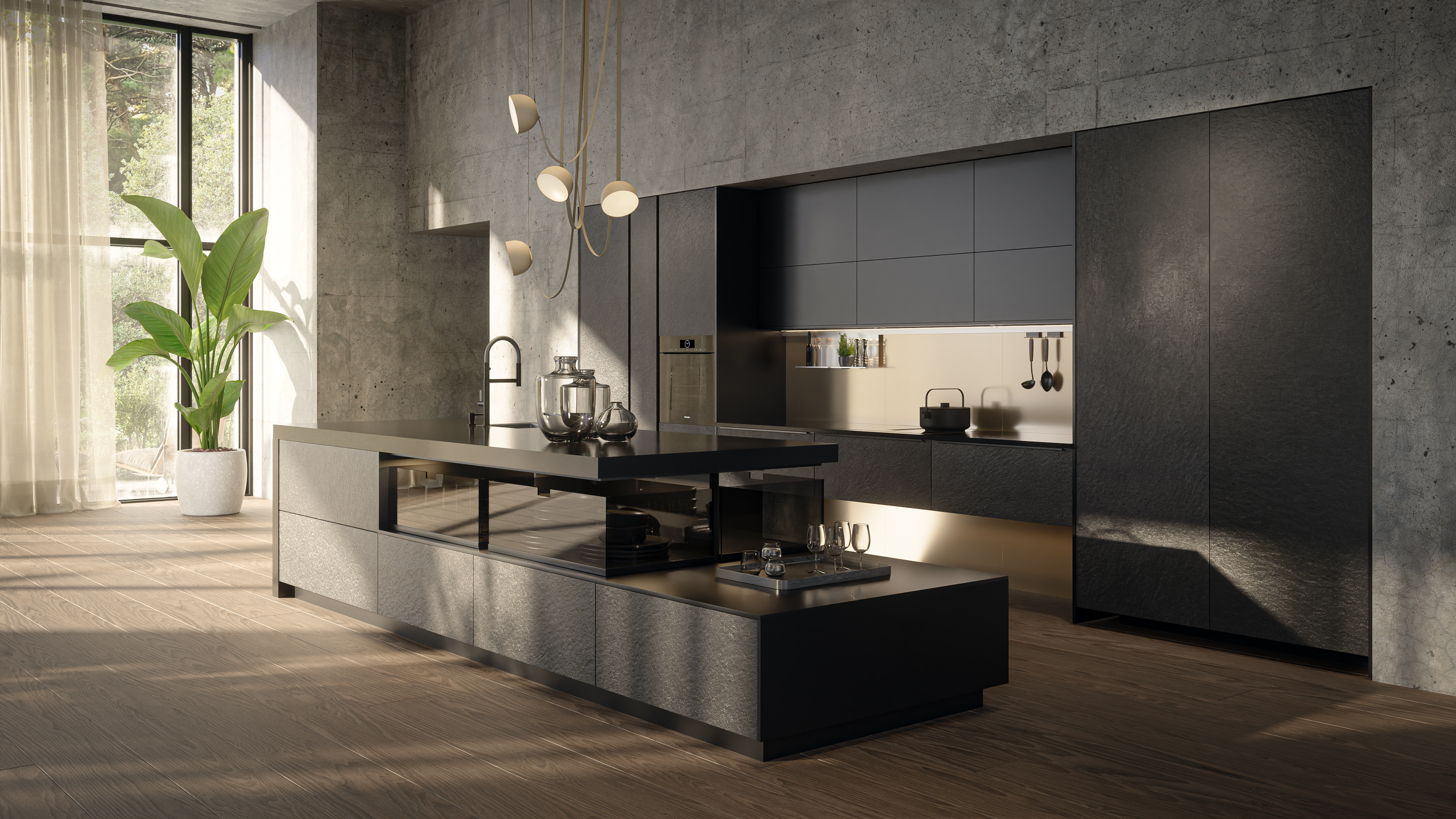
AV 7030 Black-star and AV 5015 Carbon Metallic: a dark kitchen that looks as if it were built of stone
Simply providing more clarity
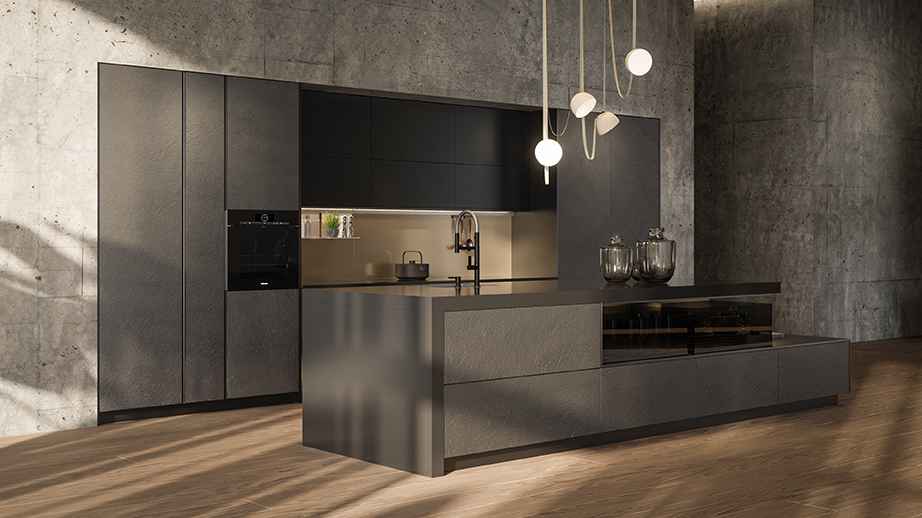
You have to look twice to realize what the cabinet fronts in this kitchen are made of. It’s real stone, finished as an ultra-thin veneer—no decorative finish, no imitation, no print. It is precisely this brief moment of confusion that underpins the entire design.
The result is a dark kitchen with architectural clarity and a tactile quality you don’t find just anywhere. The cabinet fronts are simply structured; the large countertop appears to float, and everything else takes a back seat.
Understated in form, uncompromising in the impact of the single material that defines the space. You can see just how deep the design possibilities of this premium line go in Häcker’s systemat product world.
Stone veneer: real stone as a front material
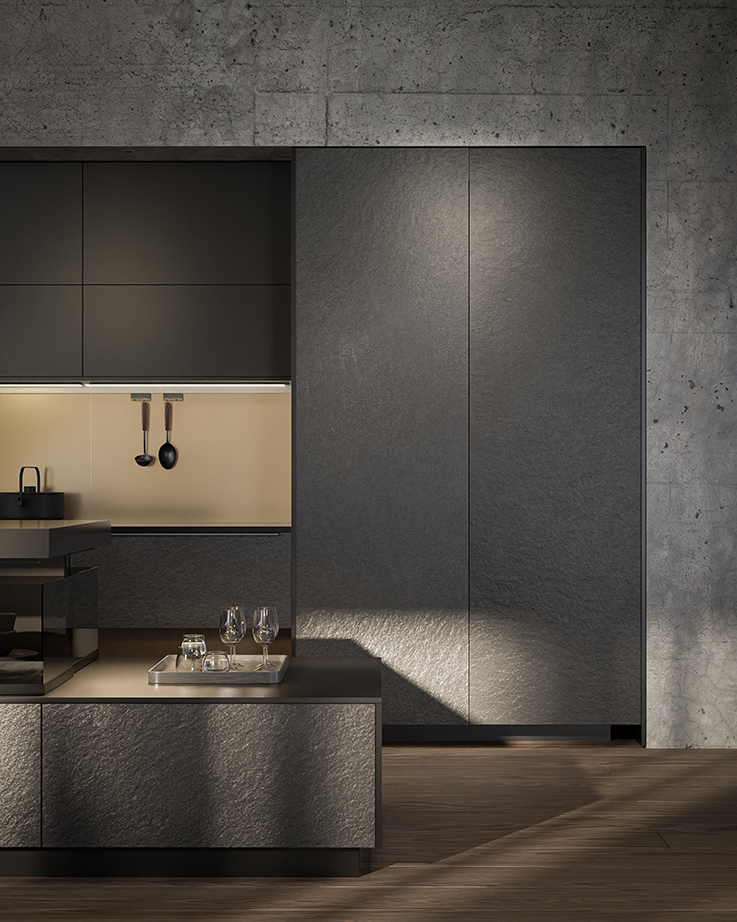
Stone veneer refers to natural stone that has been cut into wafer-thin layers and used as a cabinet front. The Black-star finish is black with fine inclusions that briefly sparkle in raking light—hence the name. In a room, the result appears as a deep anthracite with a silvery sheen, rather than a flat black.
No printed decor can replicate this. Because the stone is natural, every surface is unique: the inclusions are never exactly the same twice, and no two fronts are alike. Every appearance is completely unique.
The texture also reveals the material. The surface has a noticeable texture, not smooth—you can recognize stone by touch before you even name it. Stone veneer is one of the front materials available exclusively from systemat.
Carbon Metallic: The Second Material Layer
The wall cabinets and base cabinets feature the AV 5015 model in the Carbon Metallic finish—a polymer-glass front. A 2-millimeter-thick polymer coating creates the satin-matte, shimmering glass look. The surface is velvety smooth, impact-resistant, and highly scratch-resistant.
Two dark materials side by side, yet neither surface is overshadowed by the other: This works because it’s texture—not color—that sets them apart. The stone is textured and matte, while the polymer glass is smooth and has a slight metallic sheen.
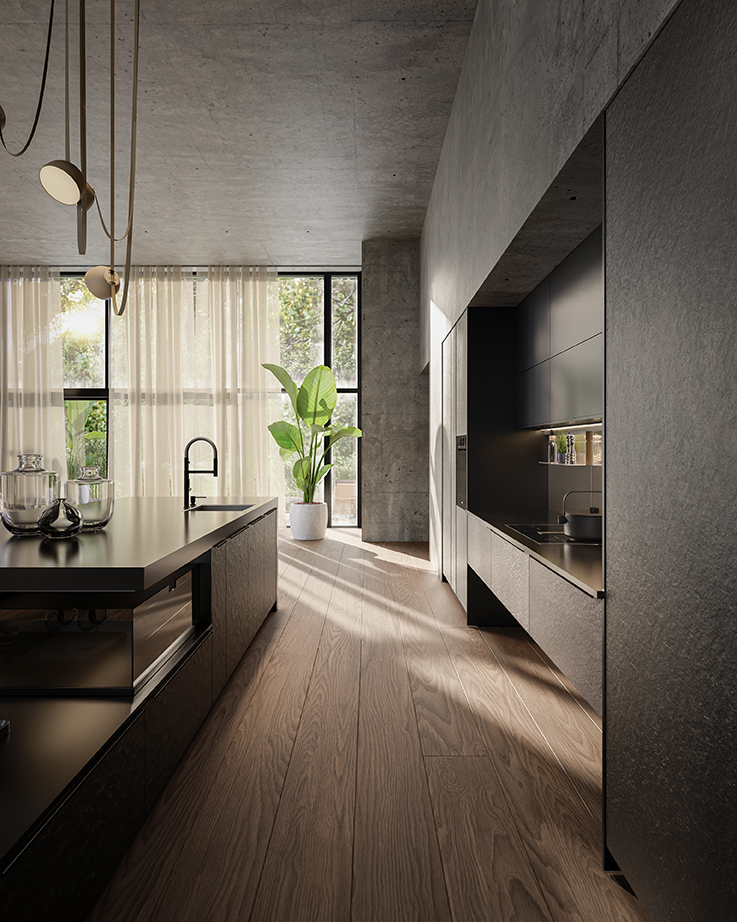
This becomes most apparent as the day progresses. When the light falls at a flat angle, the stone’s texture stands out, while the line remains calm. When the sun is higher in the sky, the relationship is reversed. A designer kitchen that changes with the light, rather than always looking the same.
Designed to be handle-free: Uninterrupted surfaces
This kitchen is completely handle-free. No trim, no handles, nothing to interrupt the surface—thus preserving the minimalist character of the cabinet fronts.
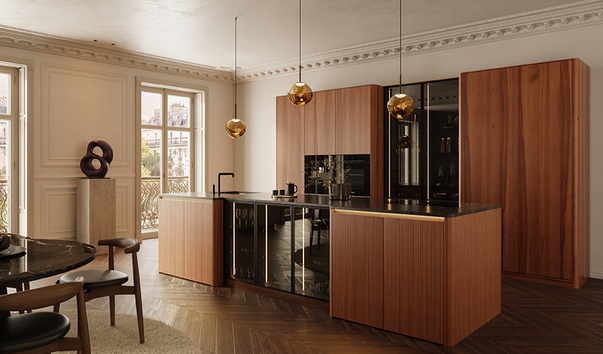
The large countertop made of Silk Negro Naturale, dark and matte, appears to float above the cabinets. This impression is reinforced by the glass-fronted, illuminated storage space below, which visually lifts the island off the floor.
The niche cladding provides a warm counterpoint: a reflective surface in a champagne tone, backlit. It prevents the dark palette of materials from appearing too closed off. Read about what makes a handle-less kitchen work in everyday life in the kitchen magazine.
Pocket Doors with a Fine Oak Frame
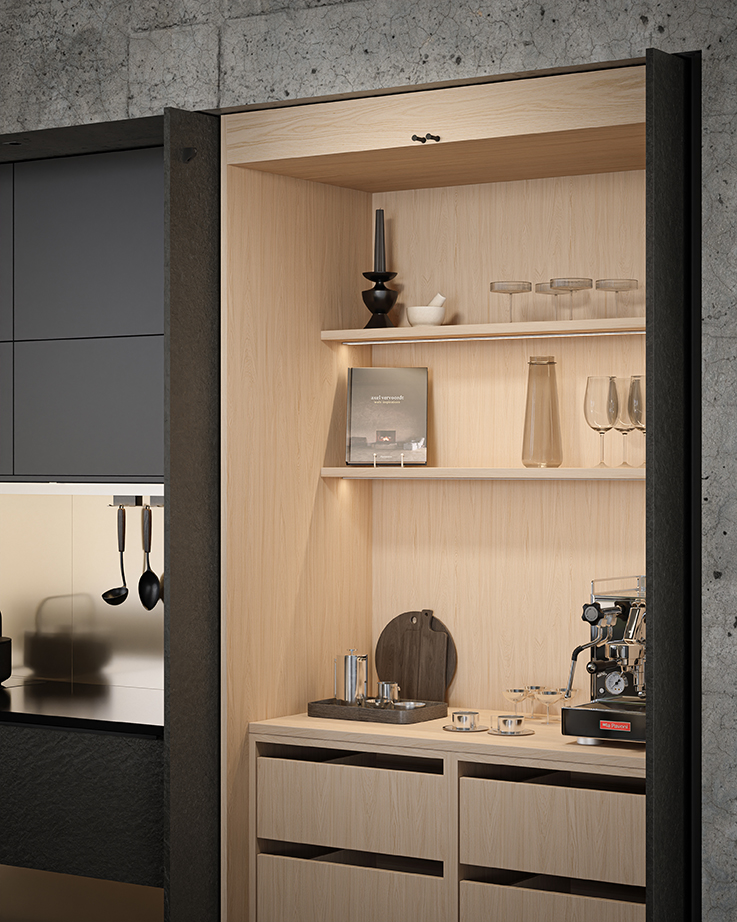
Pocket doors are doors that slide to the side and then disappear into the side of the cabinet. They don’t protrude into the room like an open hinged door, and when closed, the tall cabinet wall once again forms a seamless surface.
The kitchen takes on a surprising sense of lightness the moment these doors open. Behind them lies a cabinetry system made of light-colored fine oak with illuminated shelves, open compartments, and its own countertop—light wood that briefly breaks through the dark palette of materials.
The area is set up as a coffee station; it could just as easily be designed as a bar area. The benefit is the same: Everything remains set up and within reach, and everything can be cleared out of the room in seconds.
Glass Shelves as a Design Element
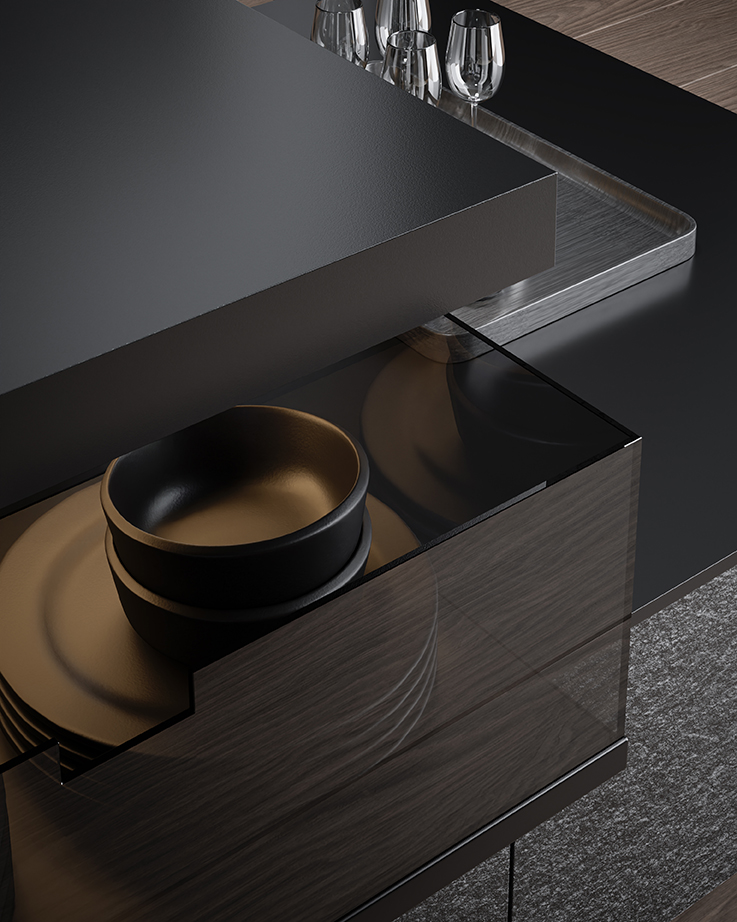
The island features glass-fronted, illuminated pull-outs. They reveal their contents without displaying them openly—glasses and dishes remain behind glass, yet are visible.
For the solid island, this creates depth: the solid stone surface gains a layer that lets light through. Here, organization becomes a design element rather than a necessity.
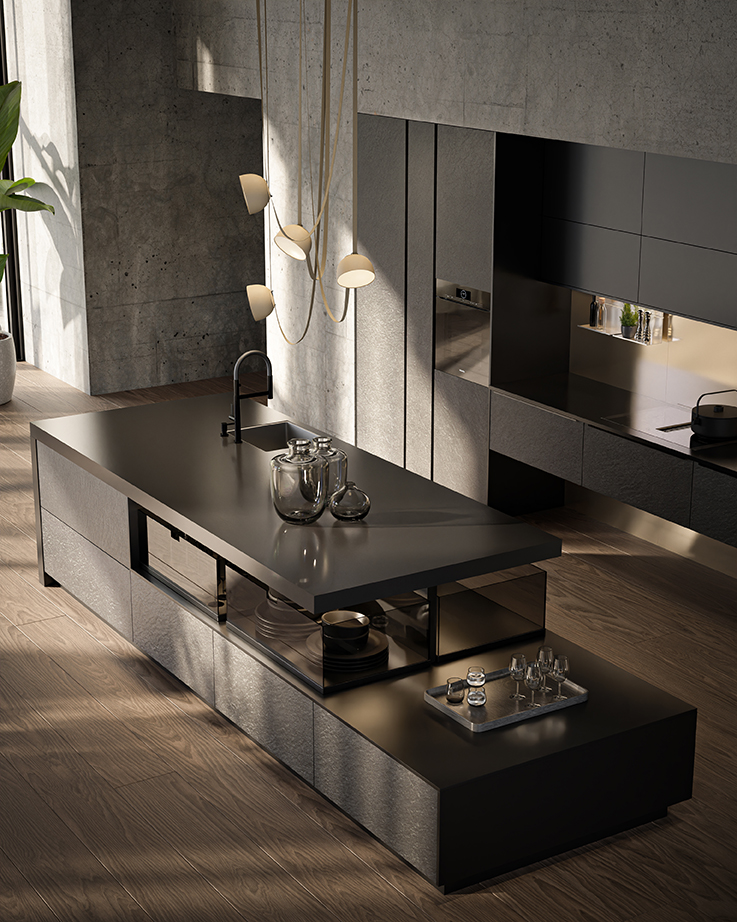
The spacious kitchen island
The island is the centerpiece of this kitchen and, at the same time, the feature that makes the most use of the material. To ensure it remains so, it needs space: about one meter from the counter and walls, so that drawers can be opened while someone is working next to them.
Dark surfaces also need light and space. In this design, both are provided by floor-to-ceiling windows and a backlit niche—in a smaller room, a lighter-colored kitchen unit would be the better solution. An article in Kitchen Magazine shows how to properly position a kitchen island in the floor plan.
Here, the cooktop was planned along the wall unit, not on the island. If you want to place your cooktop on the island, be sure to plan for the exhaust hood at the same time: a cooktop with an integrated range hood and a ceiling fan are both equally suitable for this purpose. Häcker’s kitchenstyles will help you determine which overall kitchen design suits you best.
systemat: where entitlement is at home
With this kitchen, the authenticity of the materials isn’t just an added bonus—it’s the very essence of the design. Stone veneer made from natural stone, polymer glass with a 2-millimeter-thick coating, genuine natural stone countertops: Every surface is exactly what it appears to be.
This is what gives it its individuality. Every stone veneer front is one-of-a-kind because the stone itself is—this isn’t just a claim, but an inherent property of the material. The light-colored fine oak cabinetry behind the pocket doors shows just how far the design extends to the interior.
The same high standards apply to the interior as well. The SDL pull-out features the narrowest frame on the market. The frame supports the front: the narrower it is, the more interior space you have. Add to that a cabinet depth of 61 centimeters instead of the standard 56—that’s about ten percent more storage space in the base cabinet.
Behind this premium kitchen stands a family-owned business that has been in operation since 1898 and is now run by the fifth generation. Manufacturing takes place in Germany, at two locations across five plants. Häcker offers a 5-plus-5-year warranty on the “systemat” line.
Stone veneer is meant to be touched
A Häcker dealer near you can advise you on cabinet fronts, colors, and planning.
Discover more Häcker kitchens from the systemat product range
![[Translate to English:] AV 6085 Eiche-schwarz | AV 6088 Eiche-schwarz](/fileadmin/_processed_/4/6/csm_AV6085-GL_Eiche-schwarz_1700x1200_7c008005bf.jpg "[Translate to English:]")
![[Translate to English:] AV 7080 Rauchblau](/fileadmin/_processed_/a/0/csm_AV7080_Rauchblau_f_1700x1200_da6a52f53a.jpg "[Translate to English:] AV 7080 Rauchblau")