Which material is durable and easy to care for? Which installation style complements your countertop? And what size really fits your daily routine? In this article, we’ll show you what to look for when choosing your kitchen sink.
Easy to clean, hygienic, and stylish: Which material is best for kitchen sinks?
The material of your kitchen sink determines its appearance, ease of care, and feel. It also determines how durable the sink is in everyday use. Stainless steel, ceramic, and quartz or granite composite are among the most common options. Each material has its own strengths.

Stainless Steel: The Timeless Classic
Stainless steel sinks have been a trusted choice in kitchens for decades. The material is durable, heat-resistant, and hygienic. Its neutral look complements many kitchen styles—from clean and minimalist to classic and cozy.
In everyday use, stainless steel reliably demonstrates its strengths. Hot pots, frequent washing, or contact with water are no problem for a high-quality stainless steel sink. Depending on the finish, however, scratches, limescale marks, and fingerprints may be more visible. Brushed or satin-finished surfaces have a more subdued appearance and are more forgiving of minor signs of wear. When making your selection, it’s worth paying attention to the material thickness and craftsmanship. Thinner sheets can sound louder when dishes hit them.

Ceramics: Character and Texture
Ceramic sinks make a distinctive visual statement in the kitchen. The surface is available in glossy or matte finishes and in a variety of colors, and it brings a handcrafted flair that pairs particularly well with country-style or classically designed built-in kitchens. Something to keep in mind during planning: Ceramic is heavy. Installation requires a sturdy substructure and should be performed by a professional contractor. And while the hard surface is extremely scratch-resistant, if porcelain or glass hits it, the damage will be to the dishes, not the sink.

Quartz: Modern, durable, and exceptionally easy to maintain
Quartz sinks are among the most popular materials for kitchen sinks today—and for good reason. The surface is resistant to stains, heat, impacts, and scratches. It feels slightly rough to the touch but is not porous, which makes hygienic cleaning particularly easy.
A noticeable everyday advantage: water spots and fingerprints are barely visible on quartz surfaces. Limescale stains can be easily kept at bay with regular dry wiping and a mild cleaning agent. Add to that modern colors like matte black, dark gray, or light gray—the stone-like texture conveys a sense of high quality, calm, and warmth all at once.
The granitecomposite sinks from Blaupunkt—such as those from the MAIRA or ALENTO series—embody precisely these qualities. They feature durable surfaces in modern colors and can be seamlessly integrated into a variety of kitchen designs. Blaupunktbuilt-in appliances are part of the Häcker product line and can be directly integrated into kitchen designs.
From above, from below, or flush: Types of kitchen sink installations
How a sink fits into the overall look of the kitchen depends not only on the material—but also on how it is installed in the countertop. The installation method affects the appearance, ease of cleaning, and the requirements for the countertop itself.
Countertop sink: classic and simple
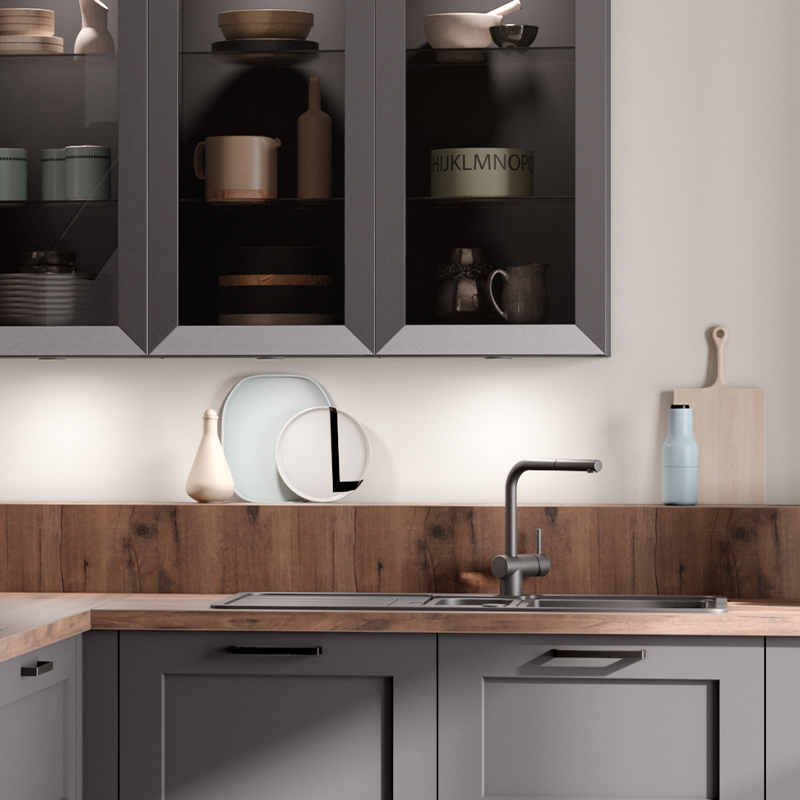
With a countertop-mounted sink, the basin is installed into the countertop from above. The rim is visible on the countertop surface. This solution is tried-and-true, versatile, and suitable for many countertops. It’s practical for everyday use because water can be wiped right up to the rim of the basin. The visible rim is part of the design and should therefore be carefully chosen to match the countertop and faucet.

Under-mount sink: sleek, minimalist, and easy to clean
An undermount sink is installed from below onto the countertop. The rim of the sink remains hidden, and the countertop ends directly at the sink. This creates a clean, modern look. This installation method is particularly easy to clean. Crumbs or water can be wiped directly into the sink. However, it is important that the countertop is suitable for this type of installation. Sealing and installation should also be carried out carefully.
Flush-mount sink: precisely integrated
The sink sits flush with the countertop—no rim, no transition. This option is considered the highest-quality of the three and creates a particularly striking effect in modern or minimalist kitchen designs. Installation is more complex and requires precise craftsmanship.
Most Blaupunkt sinks are available in different installation styles—from the classic countertop model to the flush-mount version. Which style is best suited for a specific situation depends on the chosen model, the countertop, and the desired kitchen design.
Size, Shape, and Practical Features
Choosing the right size for a sink isn't just a matter of space. It's closely tied to your cooking habits, the available counter space, and the size of your household. The shape, number of basins, and accessories also make a significant difference in everyday use.
Rectangular or round sink?
Round sink shapes have a soft and understated look. If you want to make the most efficient use of the available space, a rectangular sink is usually the better choice. Pots, pans, and baking sheets are easier to fit inside.
Rectangular sinks also complement modern kitchens with clean lines. Round models, on the other hand, can provide a soothing contrast to straight-lined cabinet fronts.
Single basin or double basin?
A double sink is practical when several tasks are being done at the same time. One basin can be used for dishes, and the other for fresh food. This offers convenience, but requires more space.
A spacious single sink is often the better choice if the kitchen is compact or if the dishwasher handles most of the dishwashing. It has a minimalist look, offers plenty of space in the basin, and makes the countertop appear less cluttered.
What is the right sink size?
There’s no one-size-fits-all answer. The key factors are available counter space, the width of the base cabinet, and how the sink will be used. For a two-person household, a sink about 50 to 60 cm wide is often sufficient. If you frequently wash larger pots, baking sheets, or pans, you should plan for a wider sink.
A width of 70 to 80 cm provides noticeably more comfort. At the same time, the sink requires more space in the base cabinet. Therefore, the size should always be planned in conjunction with storage space, waste separation, and the faucet.
With or without a drainer?
A built-in drainboard is convenient when dishes are placed right next to the sink. It protects the countertop from water and offers added convenience in everyday life.
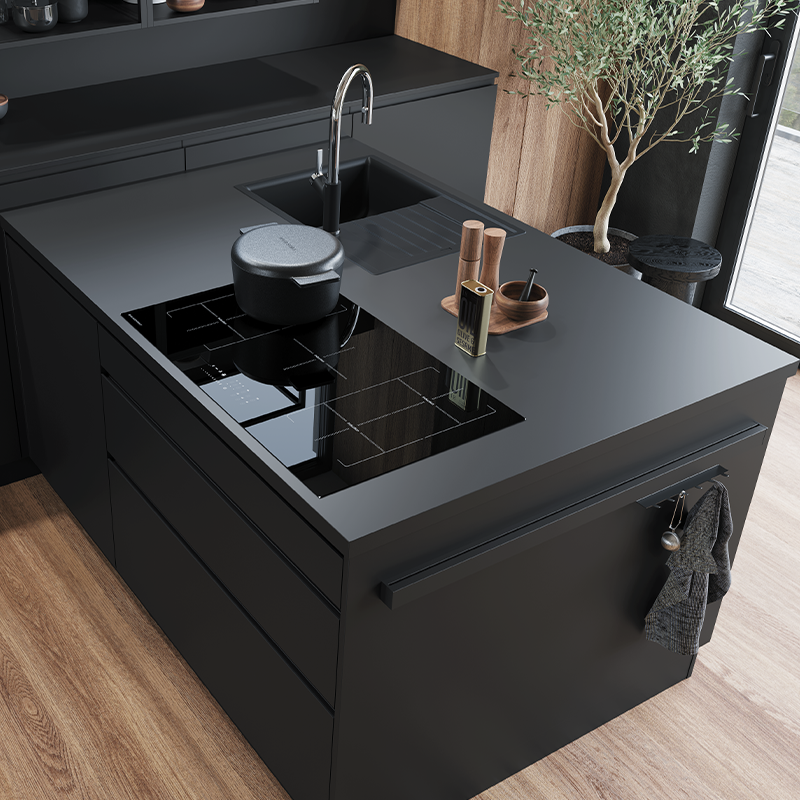
If you mainly use a dishwasher, you can easily do without the drainboard. Sinks without a drainboard have a particularly clean and minimalist look. They leave more visible counter space and pair well with modern kitchen islands.

Screen basket with eccentric drive
A small detail can make everyday life noticeably easier. With a strainer basket featuring an eccentric-operated mechanism, the drain is opened and closed using a rotary knob. This way, you don’t have to reach into hot or dirty water.
It may seem like a minor detail, but it’s practical and hygienic. Especially in frequently used sink areas, it’s worth considering such design details early on.
The Right Faucet for Your Kitchen Sink
Does every faucet fit every sink? Not necessarily. The faucet and sink must be compatible visually, technically, and functionally.
Many sinks come with a pre-drilled hole for the faucet. Alternatively, the position can be customized depending on the material and model. For undermount sinks, the faucet is often mounted directly into the countertop. This should be taken into account early in the kitchen planning process.
Fixed outlet or pull-out outlet?
A pull-out faucet spout can be extended using a flexible hose. This makes it easier to rinse the sink, fill tall containers, and wash large pots.
A fixed spout is more traditional and usually easier to maintain. However, it offers less freedom of movement. Which option is better depends on your habits and the size of the sink area.
Single-lever faucet or two-handle faucet?
A single-handle faucet allows you to quickly adjust the temperature and water flow. It’s convenient, hygienic, and especially practical for everyday kitchen use.
A two-handle faucet has separate handles for hot and cold water. It allows for precise control and has a more classic look.
Technical Note on Hot Water Production
In many kitchens, high-pressure faucets with two connections are standard. If a non-pressurized under-counter unit is used, a low-pressure faucet with three connections is usually required.
This should be checked early on to ensure that the faucet, connections, and sink area are compatible.
Form as Part of Kitchen Design
The shape of the faucet also influences the overall look. An L-shape echoes the clean geometry of a square sink. It has a linear, understated appearance. A curved spout is softer, more prominent, and draws the eye more strongly.
This way, the faucet becomes not just a technical solution, but a design element. This coordination is particularly worthwhile in open-concept kitchens or kitchens with islands.


Conclusion – Finding the Perfect Sink for Your Kitchen
A sink is more than just a functional detail. It shapes daily routines, the look of the countertop, and the balance of the entire kitchen. The material, installation type, size, and faucet should therefore not be considered in isolation.
Stainless steel stands out for its versatility and hygiene. Ceramic brings character and durability to the kitchen. Quartz and granite composites look modern, are robust, and are easy to maintain. Then there are questions about installation type, drainboard, basin shape, and matching faucet.
The good news: With a well-thought-out overall concept, you’ll make a decision that suits your everyday life in the long term. If you plan your custom kitchen with the right sink from the start, you’ll find coordinated solutions at Häcker and in the Blaupunkt range—from the basin to the faucet.
A Häcker dealer near you will help you combine materials, technology, and design in a way that makes sense. The result is a sink area that not only works well but also makes your kitchen a little more enjoyable every day.
Frequently Asked Questions About Sinks (FAQ)
For a two-person household, a single-bowl sink with a width of 50 to 60 cm is usually sufficient. If you frequently wash larger pots or want a bit more convenience, you’re better off choosing a model that’s 70 cm wide or wider. Equally important is the available countertop space—the sink should be functionally integrated without restricting the workspace.
Yes, sinks without a drainboard are very popular these days—especially in kitchens with a clean, minimalist design. If you mainly use a dishwasher, you generally don’t need a drying rack. Alternatively, you can use a separate dish rack that can be put away when not needed.
Quartz sinks are considered particularly easy to maintain: Their non-porous surface can be cleaned hygienically, and fingerprints and limescale marks are barely noticeable. Stainless steel sinks are also easy to maintain—a brushed or satin-finished surface is recommended here, as it makes water spots less visible.
In everyday language, the two terms are often used interchangeably. In technical terminology, “sink” or “kitchen sink” refers to the basin in the kitchen, while “washbasin” is more commonly found in the bathroom. Functionally and technically, the differences are minor—the relevant factors are the material, the installation method, and the appropriate faucet.
That depends on the countertop, your design preferences, and your cleaning needs. Overmount sinks are versatile and have proven themselves over time. Undermount sinks have a minimalist look and are easy to clean. Flush-mount sinks offer a particularly sleek, precise look, but require very careful planning and installation.
The faucet should be technically compatible with the plumbing, functionally suited to its intended use, and visually complement the sink. A pull-out spout offers more freedom of movement. A fixed spout has a more understated look and is often easier to clean. It’s also important to determine whether a high-pressure or low-pressure faucet is needed.