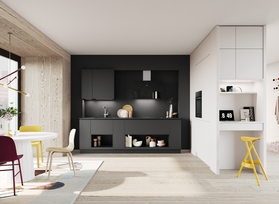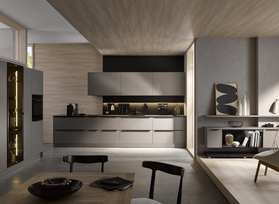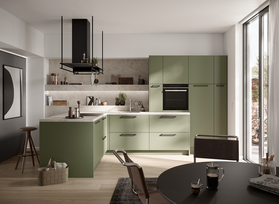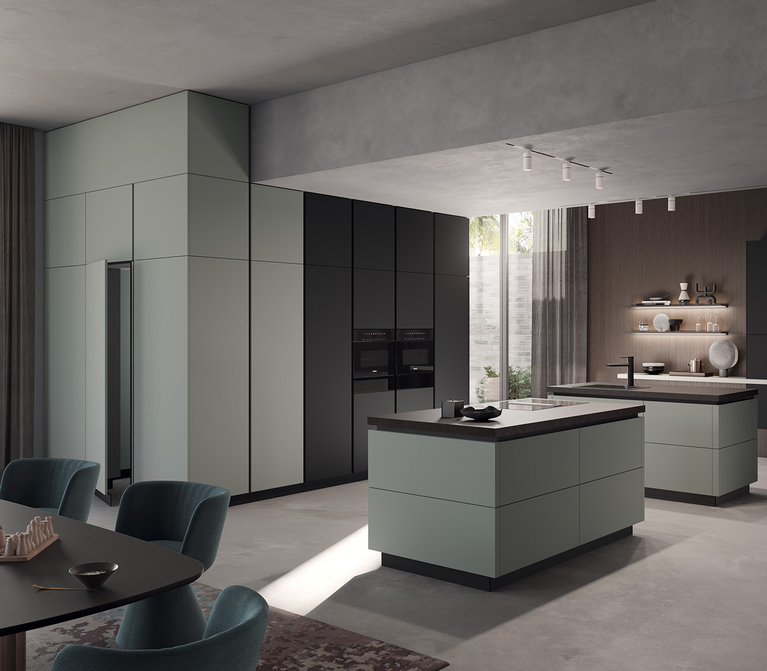
A minimalist kitchen can look this beautiful
Minimalism is often confused with austerity. A look at completed projects quickly shows that the opposite is true: precisely because there are so few distractions, the materials, colors, and light really stand out.
One example is handle-less cabinet fronts, which make an entire row appear as a single, continuous surface. Without handles, a calm pattern of joints emerges; the kitchen recedes visually, and the room comes to the forefront. We explain how this is achieved technically—using handle strips or push-to-open mechanisms—in our article on handle-less kitchens.
A second example is the minimalist kitchen layout without wall cabinets. Instead of a solid wall of wall cabinets, the wall remains open; storage space is shifted to deep base cabinets and tall cabinet units. This creates a spacious feel, even in a small area—read more about this in our article on kitchens without wall cabinets.
And third: the freestanding island as a calm focal point in the room. It brings together the sink, cooktop, and countertop in one place, freeing up the remaining walls. At Häcker, you’ll find such designs across both lines—in the Premium “systemat” line as well as in the “concept130” line.
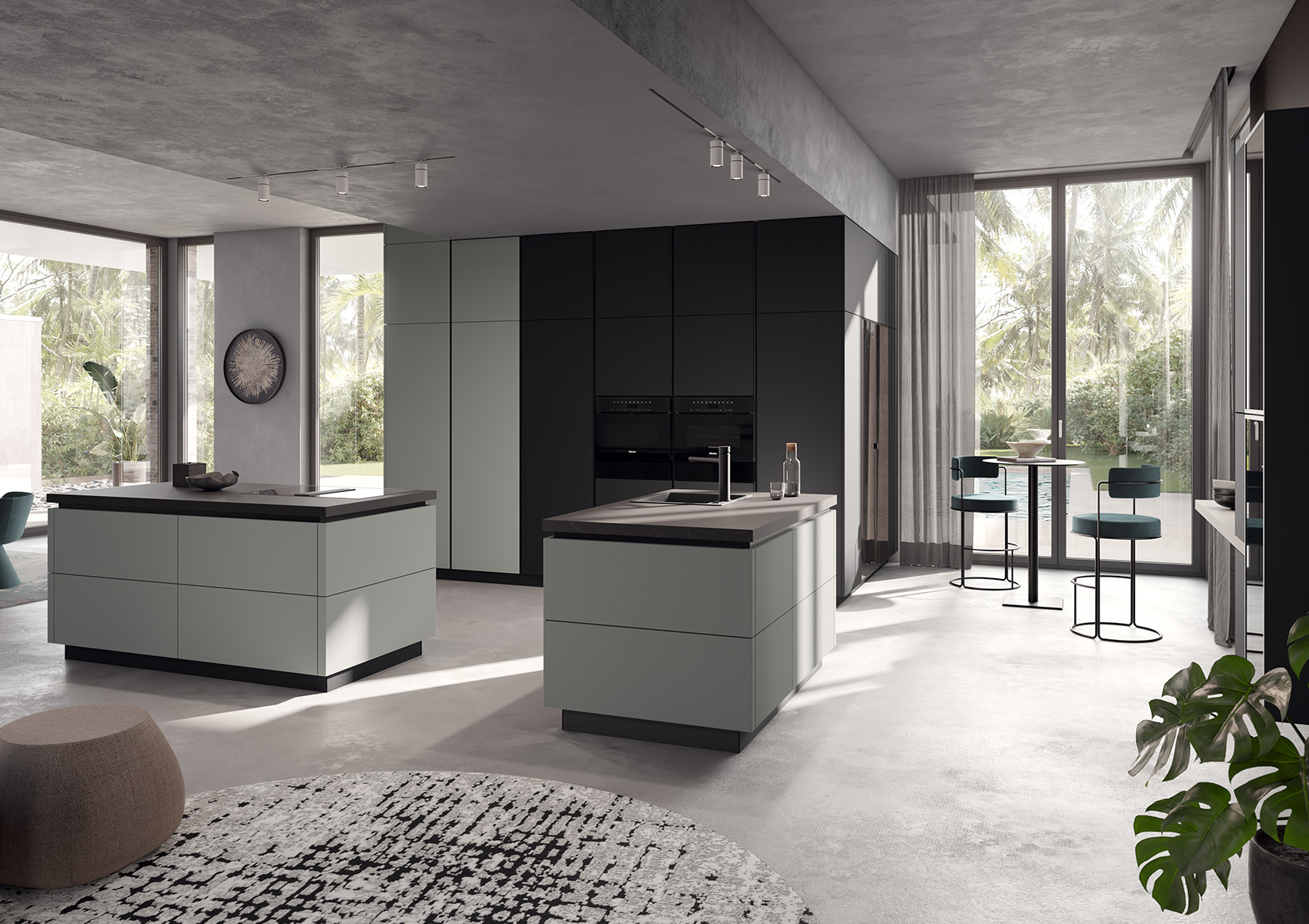
What is a minimalist kitchen?
A minimalist kitchen is stripped down to the essentials—on three levels at once: in design, in features, and in color scheme.
In terms of design, this is reflected in clean lines, smooth or finely textured cabinet fronts, and a consistent joint pattern. Visible handles, decorative moldings, and contrasting edges take a back seat. When it comes to features, minimalism doesn’t mean fewer functions, but rather fewer visible elements: appliances are built-in, small appliances disappear behind cabinet fronts, and the countertop remains uncluttered. And in terms of color, the style relies on a few coordinated tones rather than numerous accents.
It’s important to distinguish this from mere frugality. Minimalism in the kitchen doesn’t mean owning as little as possible, but rather owning the right things. The focus is on function and quality: one good knife instead of five mediocre ones, a set of pots that suits your cooking style, and tableware from a single collection rather than four different ones. Those who choose thoughtfully buy less often—and find what they’re looking for more quickly.
Thus, minimalism is both a design style and an everyday mindset. The two are intertwined: a minimalist kitchen can only remain minimalist if its contents are also minimal.
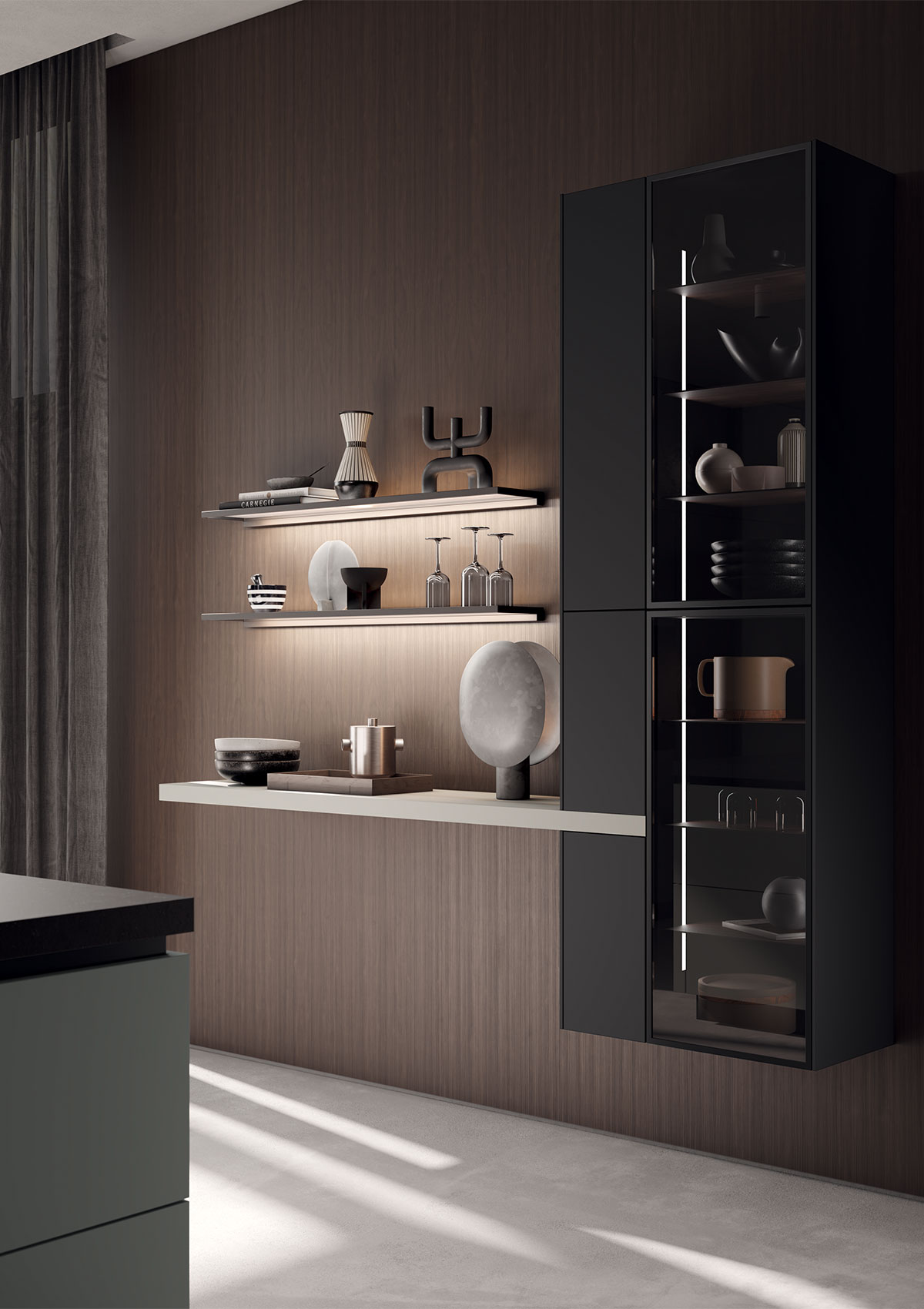
Minimalism in the Kitchen: Here's How to Get Started
The process rarely starts with a new kitchen. It starts with what’s already there.
The first step is decluttering—and that’s a personal process. What one person needs every day, another hasn’t touched in years. A tried-and-true trick: Put items you’re unsure about into a box for three months. Anything you don’t miss during that time can go for good. This takes the finality out of the decision and makes it easier.
The second step involves the countertops. Anything that sits there permanently reduces usable space and makes the kitchen feel cluttered. A coffee maker, toaster, and kettle can be stored in a cabinet with roll-down shutters, while storage jars can go on a niche rail or in a pull-out drawer. Two items may stay—no more.
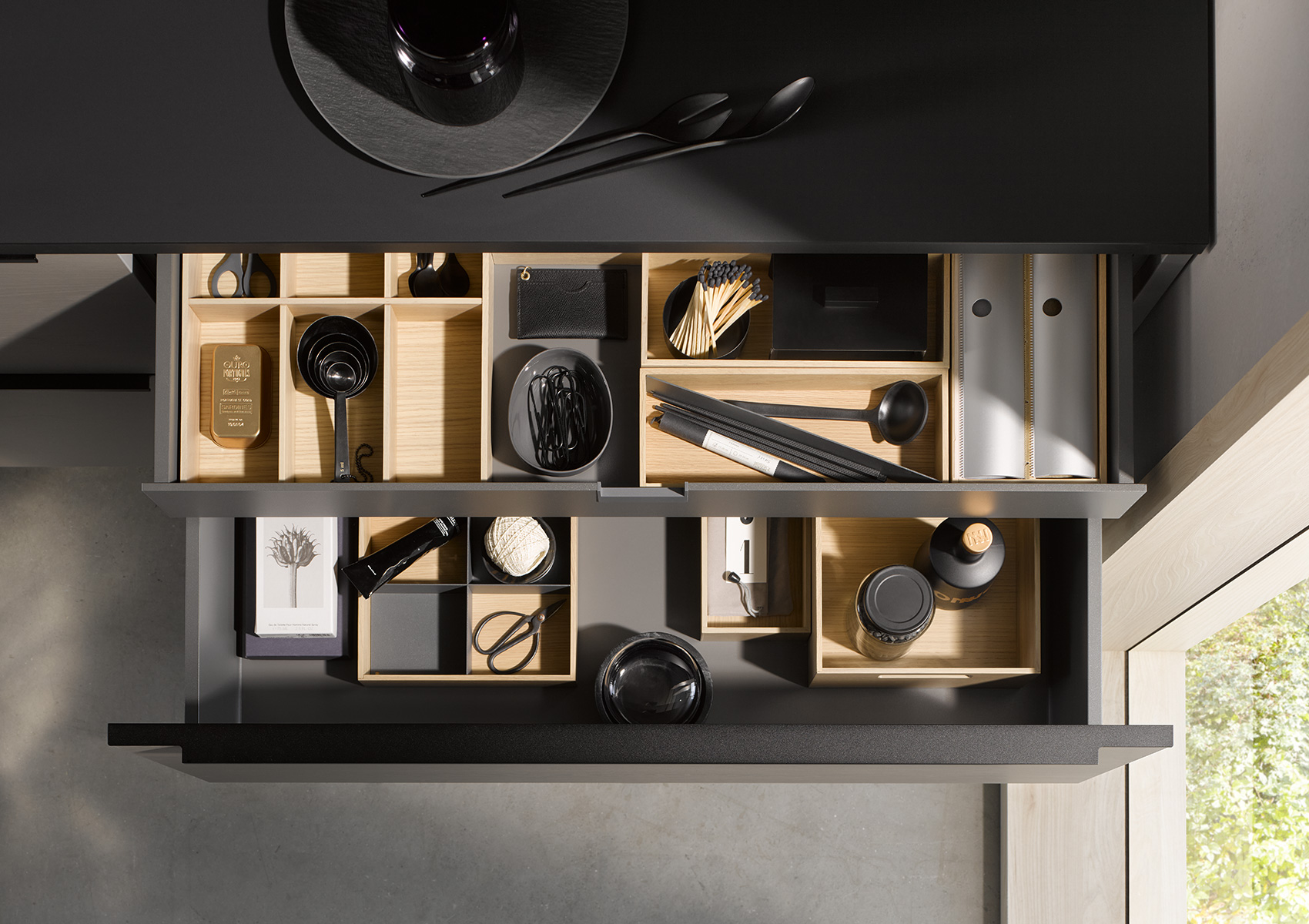
The third step involves closed storage systems. Open shelves look good in magazines, but in everyday life they create visual clutter. Pull-out drawers with fixed compartments keep things organized on their own because every item has its place. You’ll find practical instructions on this in our article on kitchen organization and on the page about kitchen organizationsystems.
And the fourth step: Reduce decor and stick to a single color scheme. Three items in related shades create a calmer look than ten colorful ones. We’ve gathered ideas for subtle accents in our article on kitchen decor.

Minimalist Kitchen Design: Tips for Planning Your Kitchen
If you’re redesigning the kitchen anyway, you can incorporate minimalism from the very beginning. Five key elements are particularly effective.
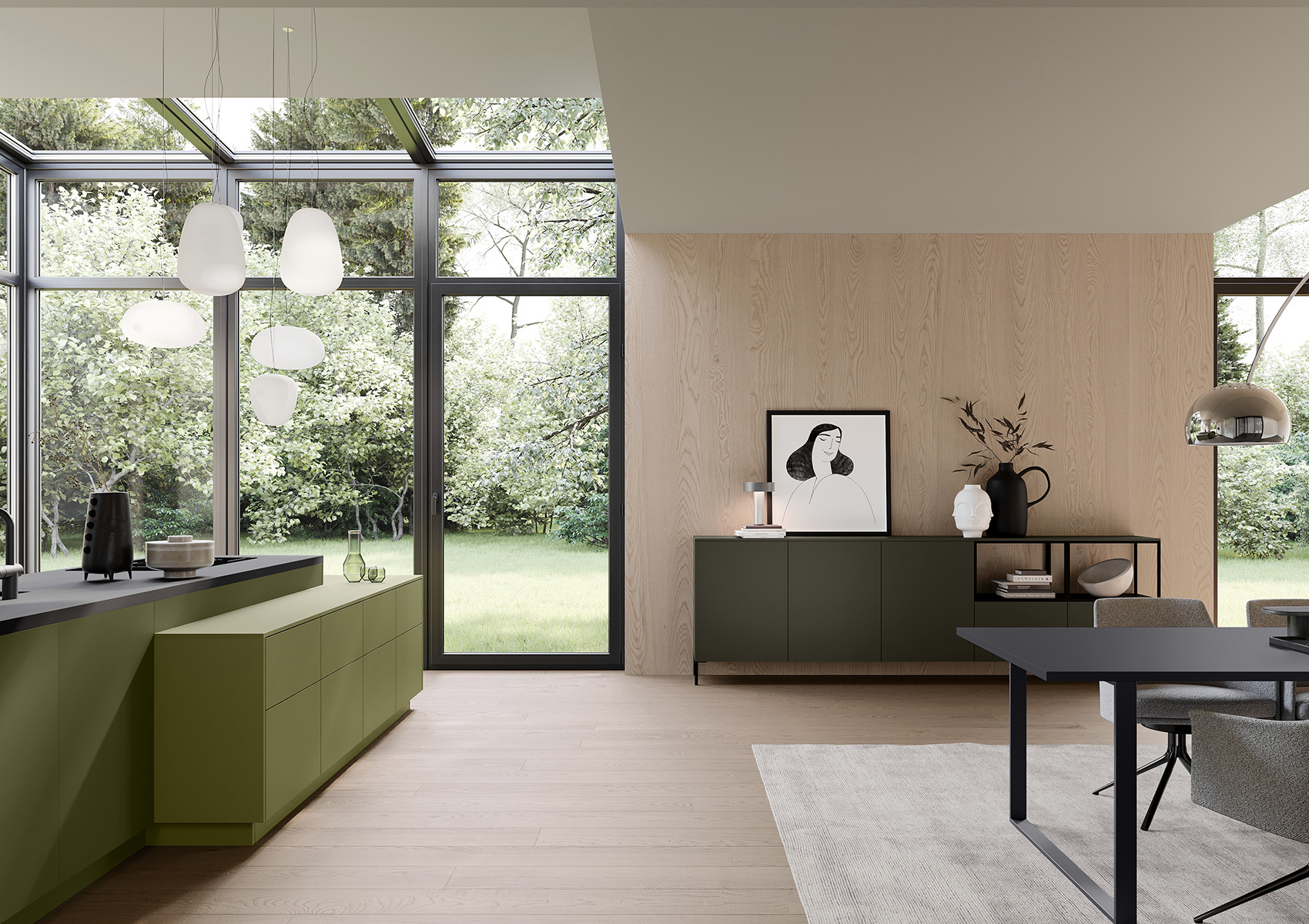
Color scheme: Minimalist doesn’t necessarily mean black, white, or gray. What matters is limiting the palette to just a few shades, not their vibrancy. A rich olive green, a deep eggplant, or a warm greige can make a kitchen feel just as serene—provided they stand alone. In the “systemat” line, cabinet fronts are painted in-house in over 2,000 NCS shades (Natural Color System, a finely graded color standard) and more than 190 RAL shades. This allows a shade to be precisely matched to the walls, floor, and lighting.
Materials: Matte cabinet fronts, real wood, stainless steel, and natural stone work well together because they reflect light softly. Velvety-matte PerfectSense surfaces, for example, soften the light while feeling luxurious to the touch. Two to three materials are enough to create a harmonious look.
Fronts and Systems: Handle-less fronts are the quickest way to achieve a calm surface. Where handles are desired, flat handle strips provide the same effect with added tactile appeal. Modular systems help to conceptualize the kitchen line, island, and tall cabinet block as a single unit.
Lighting: Indirect lighting is almost more important in a minimalist kitchen than in a more ornate one because it sculpts the space. LED spotlights under wall cabinets, illuminated niches, and glass shelves create depth without visible fixtures cluttering the room. Warm light prevents the simplicity from appearing cold—read more about this in the article on kitchen lighting.
Minimize Appliances: The fewer appliances that are visible, the more serene the space. Above the island, there are two equally effective ways to achieve this. A cooktop hood—also known as under-counter ventilation—draws fumes directly downward and keeps the line of sight completely unobstructed. A ceiling-mounted range hood is flush with the ceiling and remains equally unobtrusive; read about how it works in the article on ceiling-mountedrange hoods. The right solution depends on the ceiling structure, floor plan, and cooking habits.
Getting Organized by Decluttering: What Do You Really Need?
There’s no one-size-fits-all answer to the question “Minimalism—what do you really need?”, but it can be approached systematically.
Decluttering the Kitchen Made Easy
The quickest way is to do it in three steps. First, clear it out: completely empty a cabinet or drawer so you can actually see what’s inside. Second, categorize: cooking, baking, pantry, dishes, small appliances—group similar items together. Duplicates will become obvious on their own. Third, pare down: A good rule of thumb is to ask yourself whether you’ve used the item in the last six months. Seasonal items, like Christmas baking pans, are a given.
When it comes to tableware, it’s worth considering the set: minimalism in tableware usually means committing to a set that can be stacked, supplemented, and combined. The same goes for silverware—here, minimalism means a consistent style in sufficient quantities rather than three incomplete sets.
What remains needs a designated spot. A solid-wood cutlery tray, adjustable dividers, or Vario rods keep pots and lids in place; a pharmacy cabinet—a narrow, tall pull-out—makes your pantry supplies visible at a glance, as we describe in our article on pharmacy cabinets.
Minimalism in the Refrigerator
The refrigerator also benefits from this principle. Fewer supplies mean a clearer overview—and fewer items that get overlooked and spoil. Instead of buying large bulk packages on a hunch, a weekly shopping trip based on a rough plan is more helpful.
The rest is all about organization: clear containers for partially opened items, a designated area for leftovers to be eaten first, and proper zoning—the bottom shelf is cool for fish and meat, the middle shelf for dairy products, and the produce drawer with fruits and vegetables kept separate. When every food item has its own place, you can see in seconds what’s missing.
Minimalist Cooking—With a System
The concept doesn't end at the pantry. It's also reflected in how you cook.
A weekly meal plan takes the guesswork out of daily decisions and cuts down on impulse purchases. If you also prepare meals in advance, on busy days all you need to do is reheat them—and you’ll need far fewer appliances and pots. This not only saves time but also space in the dishwasher.
When it comes to kitchen tools, the rule is: a few versatile tools are better than many specialized ones. A good chef’s knife, a cutting board, a heavy pot, a skillet, a bowl, and a colander—with these, you can cook the vast majority of everyday meals. Food processors, spiralizers, and egg cookers are handy, but rarely indispensable. Honestly, a sharp knife and a little practice can replace most of them.
When it comes to grocery shopping, the “quality over quantity” approach also helps: less, but better. This reduces your pantry stock and makes cooking less stressful.
The most noticeable effect is felt while you’re actually cooking. With a clear countertop, you have space to chop, set things aside, and plate your food; nothing needs to be pushed out of the way. This is the real benefit, especially in compact layouts—we show how to make clever use of just a few square meters in our article on kitchens for small spaces and, for single-person households, in our article on kitchens for singles.
And finally, cleanup: Fewer surfaces in use means less wiping, less rearranging, and less dust. The kitchen is back to its original state in just a few minutes.


Conclusion: Clarity, Style, and Functionality—The Benefits of a Minimalist Kitchen
A minimalist kitchen brings three things together: a clean design that makes the space feel larger and more serene; furnishings tailored to actual needs; and a daily routine that flows more smoothly because nothing gets in the way.
Uncluttered countertops are more than just a matter of aesthetics. They eliminate sensory overload from a space that’s already the center of your day—and turn the kitchen into an oasis of calm within your home. This isn’t a sacrifice; it’s an improvement in your quality of life.
If you’d like to take the next step: You can develop your initial ideas using Häcker’s 3D kitchen planner; you’ll find all the information about this tool on the kitchenplanner page. We describe the process from planning to the finished kitchen on the “Buy a Kitchen” page—and you can find a specialist advisor near you using Häcker’s dealerlocator.
FAQ – Minimalism in the Kitchen
What appliances do you really need in a minimalist kitchen?
The basic setup is smaller than many people think: a stovetop, oven, refrigerator, and dishwasher cover the everyday needs of most households. Everything else should be based on your actual cooking habits—if you drink espresso every day, you need a machine; if you make ice cream twice a year, probably not. What matters less is the number of appliances than how they’re arranged: anything that’s built-in or tucked away behind a cabinet door won’t disrupt the calm aesthetic.
What should you keep in mind when designing a minimalist kitchen?
A minimalist kitchen unit thrives on a continuous cabinet front and an uncluttered countertop. Therefore, be sure to plan for storage space that frees up counter space: deep full-extension drawers—that is, drawers that pull out completely—a tall cabinet unit for pantry items and appliances, and a solution for small appliances, such as a cabinet with roll-down shutters. The niche is also important: A smooth, seamless niche back panel looks more serene and is easier to clean than a tiled backsplash with small tiles.
How does minimalism work in the refrigerator?
With fewer supplies and clearly defined zones. Shop for the week rather than stocking up; transfer opened items into clear containers, and designate a specific zone for leftovers that will be used up first. Also, stick to the temperature zones: fish and meat at the bottom (where it’s coldest), dairy products in the middle, and fruits and vegetables separated in the crisper drawer. That way, when you open the door, you’ll immediately see what’s there—and what’s missing.
How can I decorate my kitchen in a minimalist style?
Opt for a few larger items instead of many small ones: a bowl, a vase, a wooden cutting board. Keep the pieces in a color family that matches the cabinet fronts, and give each one a designated spot—decor that’s moved around every day looks haphazard. Plants work well because they bring life without being colorful. You’ll find more ideas for subtle accents in the article on kitchen decor.